
Dry ice blasting often gets described as a “clever” or “innovative” cleaning method, but those labels don’t really explain why it works so well. At first glance, firing frozen pellets at a surface doesn’t sound particularly scientific. In reality, the process relies on a precise combination of physics, temperature change and controlled energy transfer.
Understanding the science behind dry ice blasting helps explain why it’s used across industries ranging from food production and aviation to industrial cleaning, marine maintenance and heritage restoration.
What Is Dry Ice Blasting?
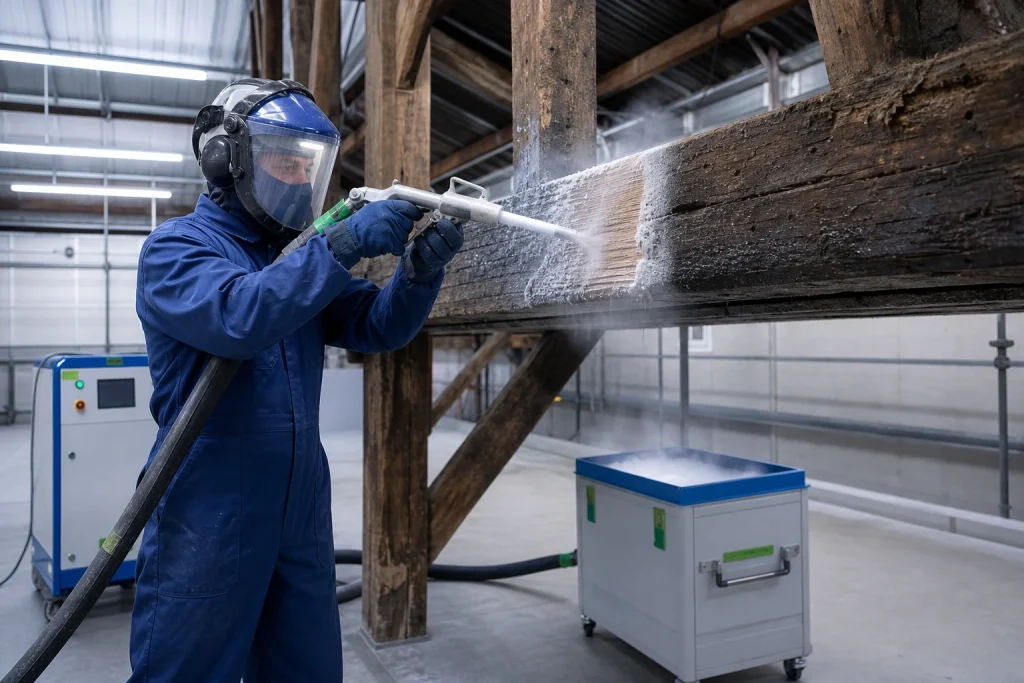
Dry ice blasting is a non-abrasive cleaning process that uses small pellets of solid carbon dioxide (CO₂). These pellets are propelled at high speed using compressed air and directed at a contaminated surface.
Unlike traditional blasting methods, no water, chemicals or grit are involved. The dry ice pellets are extremely cold, but they are also relatively soft. On impact, they remove contamination without damaging the underlying material.
Once the pellets hit the surface, they disappear entirely, leaving behind only the material that has been removed.
The Three Scientific Principles That Make It Work

Dry ice blasting isn’t effective because of one single factor. It works because three scientific processes happen almost simultaneously at the point of contact.
1. Kinetic Energy: Impact Without Abrasion
The first part of the process is straightforward physics. The dry ice pellets are accelerated through a blast hose and strike the surface with controlled force. This kinetic energy is enough to dislodge contaminants such as grease, paint, carbon deposits or biological residues.
However, unlike sand or grit blasting, dry ice pellets are not hard or abrasive. They don’t grind or etch the surface. Instead, they transfer energy just long enough to break the bond between the contamination and the substrate beneath it.
This is why dry ice blasting is suitable for sensitive materials such as electrical components, machinery housings, timber beams and stonework. The surface remains intact while the unwanted material is removed.
2. Thermal Shock: Extreme Cold at the Point of Contact
The second principle is thermal shock. Dry ice is extremely cold, at around -78°C. When the pellets hit a surface, they cause a rapid and localised drop in temperature.
Most contaminants and coatings respond to this sudden temperature change by contracting at a different rate than the surface they are stuck to. This creates microscopic cracks and fractures in the contamination layer, weakening its grip.
This effect is particularly useful when dealing with oils, fats, adhesives, resins and coatings. In food production environments, for example, baked-on residues or fats can be difficult to remove with water or chemicals alone. Thermal shock helps break those bonds cleanly and efficiently.
3. Sublimation: Why There’s No Mess Left Behind
The third and most distinctive part of the process is sublimation. Dry ice doesn’t melt into liquid when it warms up. Instead, it transitions directly from a solid to a gas.
At the moment of impact, the dry ice pellets instantly turn into CO₂ gas. This rapid expansion helps lift the loosened contamination away from the surface. Because the dry ice disappears, there’s no secondary waste to clean up.
What’s left behind is simply the removed material itself. There’s no slurry, no damp residue and no blasting media to collect or dispose of. This is one of the reasons dry ice blasting significantly reduces clean-up time and disruption.
Why Dry Ice Blasting Is Safe for Sensitive Equipment
Because the process is dry and non-conductive, it’s well suited to cleaning around electrical systems, control panels and motors. There’s no moisture introduced, which removes the risk of corrosion or electrical faults that can follow pressure washing or steam cleaning.
That said, the safety of the process relies heavily on correct setup and trained operators. Proper ventilation is essential, as CO₂ gas displaces oxygen. When handled correctly, dry ice blasting is a controlled and predictable cleaning method rather than a high-risk one.
How Dry Ice Blasting Differs from Traditional Cleaning Methods
Traditional cleaning often relies on abrasion, chemicals or water. Each has its place, but they also come with drawbacks.
Sandblasting and grit blasting can damage surfaces and create large volumes of waste. Pressure washing introduces moisture and often requires long drying times. Chemical cleaning can involve harsh substances, disposal concerns and regulatory issues.
Dry ice blasting avoids many of these problems. There’s no surface damage, no water ingress and no chemical residue. Equipment often doesn’t need to be dismantled, which reduces downtime and labour costs.
How the Science Translates into Real-World Applications
The physics behind dry ice blasting directly explains why it’s used in such a wide range of environments.
In industrial settings, it allows machinery to be cleaned in place without stripping it down. In food and dairy production, it removes contamination while supporting hygiene standards and audit requirements. In aviation and automotive work, it cleans delicate components without risk of damage.
For marine applications, the process removes coatings and fouling without harming underlying materials. In heritage and beam restoration, it allows surfaces to be cleaned gently while preserving original features.
In each case, the same scientific principles apply. Only the application and technique change.
Why Understanding the Science Matters for Clients
Knowing how dry ice blasting works helps clients make informed decisions. It explains why the process can be faster, cleaner and less disruptive than alternatives, and why it’s often chosen for high-value or sensitive assets.
It also helps set realistic expectations. Dry ice blasting isn’t magic, and it isn’t suitable for every situation. Understanding the science helps determine when it’s the right tool for the job and when another approach may be more appropriate.
Precision Cleaning Backed by Physics
Dry ice blasting isn’t a trend or a gimmick. It’s a cleaning method grounded in well-understood physical principles: controlled impact, thermal shock and sublimation. When applied correctly, those principles deliver consistent, predictable results across a wide range of industries.
By combining an understanding of the science with practical experience on real-world sites, dry ice blasting offers a precise and effective way to remove contamination while protecting the surfaces underneath.